

The majority of us have heard something along these lines from our parents: “I/we want you to be happy and successful." By saying this, of course, parents want the best for their children. However, when we ask people what it actually means to be successful, we don’t often get a clear answer, but many will say that it involves financial prosperity, at least to some extent. But you'll also hear people say: "money doesn't bring happiness". On the other hand, if you’ve ever cried or simply felt sad in the presence of others, you’ve most likely heard something along the lines of: “You have nothing to cry about, the children in Africa are starving", meaning that only poverty can be the source of sadness, or in other words, implying that hapiness and money are closely related. Confusing, isn't it?
That’s why I’m not surprised that, in conversations with people - especially those from my generation - I keep discovering that after receiving such confusing messages we have no idea what success even means, let alone how to achieve it. Some of us wouldn’t recognize success even if it knocked on our door and introduced itself by its full name. So when we enter the professional world, we end up falling into never-ending spiral of senseless searching for something abstract, magical, out-of-reach and the repeated feeling of failure. Sounds familiar? It used to be to me, too.
My success looks different from your success
During our formal education we were taught to search for the one (and only) correct answer to each question. Any deviation from that answer would usually result in a lower score or even a lower grade. This way of thinking encourages the development of convergent thinking, but at the same time it causes fear of mistakes and stepping outside the box. That’s why it’s not surprising that, when we first encounter a problem at work, in sports, or sometimes at university that has multiple solutions - some of which are better, some worse, but none are absolutely correct or incorrect - we often feel insecure because our divergent thinking skill isn't developed enough. Take a look at the video below to learn more about the differences between convergent and divergent thinking:
One of the challenges where divergent thinking is especially valuable is the pursuit of success. When it comes to this, the saying: "No two people are alike" is quite accurate. Each person has their own definition of success, and that's completely fine. Success is an abstract term that each of us defines for ourselves according to our own experiences, values, beliefs we learned from others or in any other way, as well as other factors. That's why the first step towards success is understanding what success means for us personally.
How do I discover what success means for me?
We often link the feeling of success to the achievement of our goals. That's why the first step to this pursuit is to define your goals. But, believe it or not, that's where the story often gets complicated. Why? Because sometimes it's hard to discern which goals were set by others around us(maybe even a long time ago) that we internalized in the meantime, from those that we truly want to achieve because they awaken the feeling of joy, competence, pride etc. in us.
Identification and defining of authentic goals is a longer process than we might have thought at first. But it's not impossible. To avoid making this process too abstract and seemingly endless, one of the possibilities is to follow these steps:
- Identify your values
Goals only seem authentic if they align with our values. Authentic goals motivate us "from within" - intrinsic motivation beats the extrinsic one (our social circle's demands to reach goals) - use this to your advantage! This is confirmed by research about goals and life satisfaction that shows a higher level of wellbeing after reaching intrinsic goals linked to personal growth, relationships and meaningful contributions to society - as opposed to extrinsic goals, such as status and financial gain (Ryan & Deci, 2000).
For instance, some of my values are wisdom, equity and justice. Therefore, I will hardly feel safisfied and successful if my goals aren't aligned with my values. For example, if my goal is to become a coach in the sport that I'm practicing, and I can't achieve it without depriving someone else who was maybe in deserving of that opportunity, my value of equity is compromised and after achieving that goal, I would not feel satisfied, but guilty. And the success that's visible to othersmight feel empty to me. That's one of the reasons why some seemingly successful people are unhappy - if they had to ditch their values to reach their goal, it simply cannot offer such a feeling of satisfaction and pride that achieving a goals that's aligned to our values can.

Discover your values in this questionnaire. Keep in mind that, according to some models, there are hundredsof different values, so it's nearly impossible to find a questionnaire that can cover them all, but here you can find many commonly used ones, so it's a great starting point for the conversation about values.
- Write down your goals using the SMART methodology
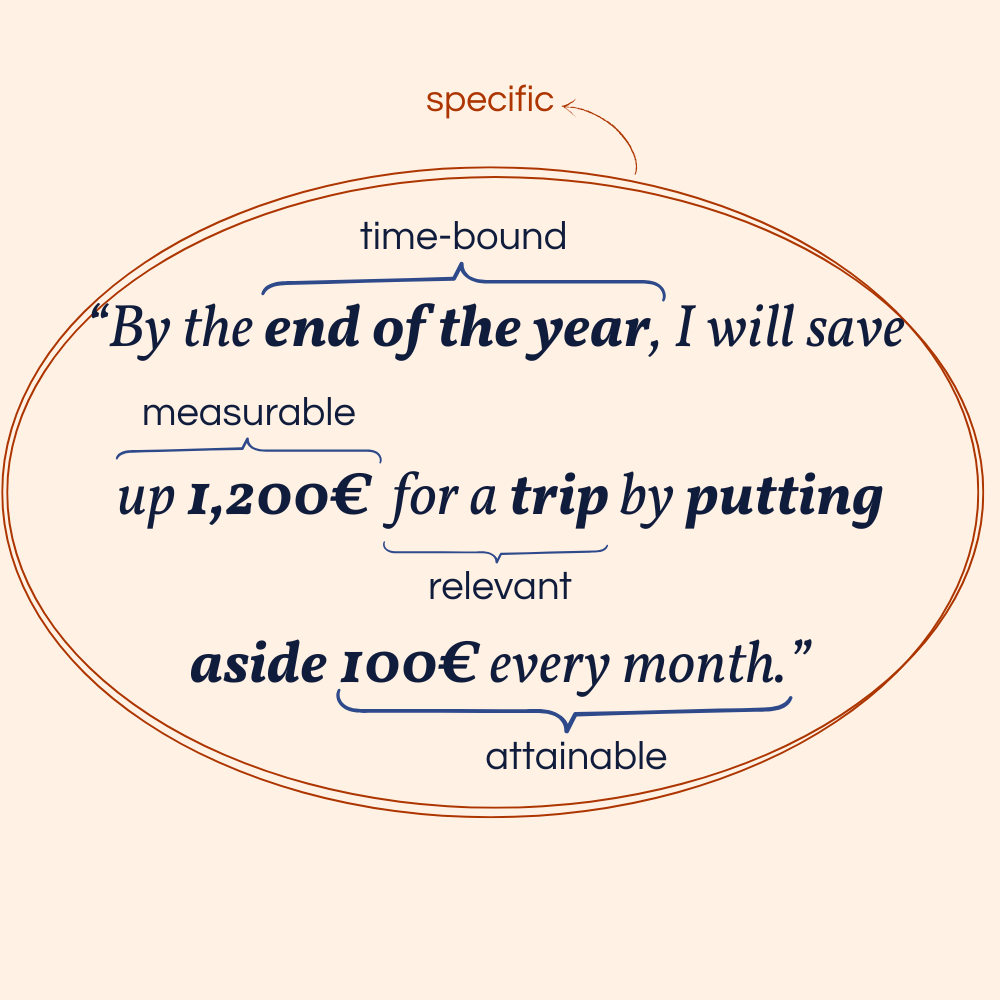
The SMART model was developed by George Doran (1981) and its name is an acronym for the 5 characteristics of well-written goals:
- Specific
Be clear in defining your goal - what exactly do you want to achieve? Breaking down a (larger) goal to smaller, more attainable steps can help by keeping your motivation steady.
- Measurable
It's important to set goals that we can measure in any way - otherwise, we won't be able to know whether we've reached it or not.
- Attainable
The ideal goal is one that is attainable, but also challengingenough. Both an unattainable and a goal that's too easy can demotivate us - the unattainable one can make us feel incompetent, and one that is too easy can be seen as boring and not worthy enough of the chase.
- Relevant
Your goal needs to be relevant to you. Here we're talking about your values again - they're a good indicator of relevance because they tell us what's really important, or in other words, relevant for us. Also, it's important for the goal to be relevant to our roles in life because that's how they can help intrinsically motivate us.
- Time-bound
Similarly to measurability, this characteristic help us approximate whether we achieved our goal or not. When setting a time limit, it's important not too use limits that are too short or too long. One of the ways of defining the time limit is to:
1st step - approximate how much time you would need to complete the goal in an ideal case.
2nd step - approximate how much time it would take to complete the goal in the worst-case scenario and
3rd step - take the value in the middle of the first two steps as your time limit.
This way you give yourself enough time to deal with unforeseen circumstances, and the possibility of procrastination lowers. Read more about this method of time limit approximation and its variations here.
Basically, instead of this:
"I want to be a better person."
we want our goals to sound like this:
- Identify which of your goals increase your feeling of autonomy
For each goal you write down, ask yourself the following question: "Is this goal authentic to me as an individual or do I want to achieve it because it's expected from me?". Take your time, be honest with yourself and analyze your goals against your values. Research shows that this step is important because achieving goals that are aligned with our values leads to 34% increase in life satisfaction and resilience compared to achieving goals that are misaligned with our values (Sheldon & Elliot, 1999).
Next to each goal, write down "Yes" if the goal is aligned to your values and true desires or "No" if it's not. Depending on the number and the complexity of the written goals, decide which ones you want to try to achieveand which don't deserve your time and effort (right now). Then, decide the order in which you can achieve them. Ask yourself is it possible to work on on multiple goals at once (especially if you have written down multiple long-term ones)? Are some goals prerequisites for some other goals? What would be too much for you, what would lead to burnout? Ask yourself all these questions (and more) to make sure you have the most accurate picture of what you want to achieve, and by when so that you would feel successful. This step also requires time and patience. Deciding what to do with your life is not an easy task to take on!
- Imagine your future
Imagine yourself achieving each of the goals you kept. Where will you be, what will you do, who will be with you, what will you see, hear, feel? Imagine the scene as accurately and in as many detailsas you can, relying on all your senses. Ask yourself the most important question: "What am I feeling?" If the answer is relief (not happiness or fulfillment), then that goal might not be aligned with your personal view of success, but rather with what others expect from you.
Ready, set, go!

After identifying, writing down and choosing the goals you want to achieve, now it's time to start. In case you haven't already, break down the big goals into more smaller, achievable steps and start taking steps to achieve them!
Bonus advice: It doesn't matter if you aren't sure where to start when it comes to the long-term goals. In most cases, you don't have to follow a perfect structure or timeline. What is important however, is to start. From any step. Why? Because research shows that once we start a task, even if we don't finish it right away, it stays in our subconscious minds and the probability of finishing the task increases by up to 90% (Masicampo i Baumeister, 2011). This phenomenon is referred to as the Zeigarnik effect (Zeigarnik, 1927). Use this as an advantage and hack your brain to help you achieve greatness!
What if we succeed?
If we allow ourselves to detach from other people's definitions of success and start exploring our own values, desires and goals, a whole new perspective of successopens up. What would happen if we stopped blindly following societal norms and instead of that, we built our own version of success based on authenticity and intrinsic motivation? We might find out that the feeling of fulfillment doesn't come from comparison with others, but from achieving goals that are aligned with our values and personal development. In that case, success would no longer be an abstract and unreachable concept, but a concrete feeling of satisfaction and meaning that we build daily.
Take your success into your own hands and write the saga of your life!
Resources
Doran, G. T. (1981). There’s a S.M.A.R.T. way to write management’s goals and objectives. Management Review, 70(11), 35–36.
Lanz, A. (2021). The min/max strategy for estimating projects. AboutBits Blog. https://aboutbits.it/blog/2021-01-19-the-min-max-strategy-for-estimating-projects
Masicampo, E. J., & Baumeister, R. F. (2011). Consider it done! Plan making can eliminate the cognitive effects of unfulfilled goals. Journal of Personality and Social Psychology, 101(4), 667–683. https://doi.org/10.1037/a0024192
Ryan, R. M., & Deci, E. L. (2000). Self-determination theory and the facilitation of intrinsic motivation, social development, and well-being. American Psychologist, 55(1), 68–78. https://doi.org/10.1037/0003-066X.55.1.68
Sheldon, K. M., & Elliot, A. J. (1999). Goal striving, need satisfaction, and longitudinal well-being: The self-concordance model. Journal of Personality and Social Psychology, 76(3), 482–497. https://doi.org/10.1037/0022-3514.76.3.482
Zeigarnik, B. (1927). Über das Behalten von erledigten und unerledigten Handlungen. Psychologische Forschung, 9, 1–85. https://doi.org/10.1007/BF02409755